
Gwinnett Family – Welsh Origins
Preamble
There has never been a proven connection in our researches between the Gwinnetts of Gloucestershire who claimed Welsh origins and their Welsh ancestors and this is an attempt to research further.
My interest was re-kindled with the publication of a book, ‘Medieval Welsh Genealogy’ by Dr. Ben Guy of Cambridge University which I purchased. It is not any easy read being more an academic treatise than a straight narrative but it is crammed with facts as known in 2020. I emailed Dr. Guy who was most helpful and did some preliminary research for us which unfortunately came up with nothing. However he suggested that as our only clue was the Arms held by the family, I contacted Thomas (Tom) Lloyd, the Welsh Herald someone well known to him who might be able to indicate a source of the Arms.
Sources
Thomas Lloyd – The Welsh Herald
Dr. Ben Guy, ‘Medieval Welsh Geneaology’
Internet – various and only if thought to be serious research.
Our proven records including The Herald’s Visitations.
Some preliminary notes
- The Welsh at the time of our ancestor had no family naming convention so a family name cannot be followed as it did not exist. Men were known by a single name with a suffix to indicate a regional area, physical characteristic or other feature of note. Even the English Royal Family did not have a recognizable family name until the Plantagenets who themselves took the name from the sprig of genet or broom that Geoffrey of Anjou displayed on his hat or helmet.
- The Welsh had a highly developed knowledge of their pedigree and almost everyone knew of at least 4 generations with notables and the educated as a matter of pride knowing 7 generations or more.
- Welsh were not automatically allowed to own land in England until the reign of Henry V111.
Where to start
The facts as we know them are:
- George Gwynnedd or Gwyneth was resident in Badgeworth in 1575 when known as ‘a Vicar’s farmer’ which was a tax or tithe collector for the local church. The term ‘farmer’ was not as we know it but comes the French ‘fermier’ meaning tax collector. One assumes that through this employment they were able to buy their own agricultural land and become what we know as ‘a farmer’.
- George evidenced by the 1623 & 1682/3 Herald’s Visitation felt the family had a strong connection with Caernarvonshire and North Wales.
- The Herald’s Visitation of 1682/3 indicates that the family bore Arms as follows: Azure a chevron between three spear-heads erect Argent embrued at the points proper.
- In the Herald’s Visitation of 1623 it states simply that ‘George Gwyneth descended out of Carnarvonshire in North Wales.
- In the Herald’s Visitation of 1682/3 it states that, ’George Gwynedd alias Gwyneth, Gent. Born in Carnarvonshire a descendant of as antient (sic) family there; fled from his native country by reason of his persecution under Queen Mary and settled at Great Shurneton alias Shurdington in the Parish of Badgeworth, County of the City of Gloucester where he lived to a great age and dying 5 Dec. 1604 lies interred in a fair altar tomb.
At the suggestion of Dr.Guy I contacted Thomas Lloyd, the Welsh Herald giving him the 5 facts which included the description of the Arms asking for his interpretation of them. He has been most helpful from the outset and a pleasure to deal with.
A result and a likely starting point
I can do no better than quote from Tom Lloyd. ‘As for the coat of arms, with the chevron between three spear heads dripping blood, this must derive back to the chieftain Nefydd Hardd who is recorded as living in the Nant Conwy valley in Caernarfonshire in the 12th. century. He is recorded as head of the sixth Noble Tribe of Wales and various ancient families from that area claim descent from him and carry his arms, some with variations on the colours or tinctures, as in the case of the Gwinnetts who have a blue field to the coat rather than the silver of Nefydd’s original coat which was otherwise the same’.
Arms of Nefydd Hardd
Having examined the ancestry and descendants of Owain Gwynedd, Prince of Wales and almost exact contemporary of Nefydd Hardd he drew the following conclusion. ‘Is this the ancestry of the Gwinnetts? It seems not. The problem would be why they bore the arms derived from those of Nefydd Hardd not those of Owain Gwynedd; they lived at the same time and were not related. I suspect that they Gwinnetts took the name later when they left Wales as you suggest’. I had suggested earlier to Tom that perhaps they took the name Gwynedd as a family name or variations of to acknowledge their North Wales origins and he seems to accept that as real possibility. In the same way, Owain Gwynedd did not continue a family name but took the name of the geographical area over which he was Prince and overlord.
I think we have to accept that it is likely on the authority of Tom Lloyd that Nefydd Hardd was our possible ancestor.
Nefydd Hardd
Nefydd Hardd, 1105-1168 was head of the 6th of 15 Noble Tribes of Wales. His name translates as Nefydd the Fair, Handsome or Good Looking and the family put great store by education such as it was in the 11th. & 12th. centuries. His father was Ieuen Ysgolhaig (Scholar) and grandfather Ysbwys.
Nefydd had 3 sons Rhufan, Iowerth and Dunawd of whom the youngest Dunawd was reputed to be intellectually sub-normal. Nefydd was Lord of Nant Conwy and held the lands in the valley and at the head of the Machno River called Penmachno. His overlord was Owain Gwynedd, Prince of Wales and they, although not related were personally close. So much so that Nefydd was given wardship of Idwal the son of Owain. Legend has it that whilst Idwal was in the care of the family he was drowned by son Dunawd in what is now known as Llyn Idwal where so it goes no birdsong will be heard and no bird will fly over it.
Owain understandably was devastated and in his anger reduced Nefydd’s family to ‘bondsmen’. There is no record that their landholdings or wealth were reduced but certainly their status and influence were.
Of Nefydd’s 3 sons, Iowerth b.abt. 1140 inherited the lands and has potentally an interesting line to be followed later.
Lester Durbin
email: jeanles.1@bigpond.com
December 2022
Gwinnett Family – Welsh Origins 2
Preamble
Having established a starting point – but not proved without doubt- that our family may have descended from Nefydd Hardd,the following lines can be followed based solely on established authorities in the field.
Sources
Dr. Ben Guy, ‘Medieval Welsh Geneaology’
Ancient Wales Studies #12 – BRAINT HIR based on work of Peter Bartrum and Harlian Pedigrees
Ancient Wales Studies: Nefydd Hardd of Nant Conwy by Darrell Wolcott.
Ancient Wales Studies: Pedigree of Ednowain Bendew 11 by Darrell Wolcott.
Peter Bartrum various
Pedigree of Ednowain Bendew 11 by Darrell Wolcott
Michael Siddons ‘Development of Welsh Heraldry’.
Translations – Welsh to English.
ap = son of
verch = daughter
ferch = a girl
‘dd’ in Welsh is pronounced ‘th’
‘w’ in Welsh is pronounced ‘oo’.
Notes
It soon became apparent that probably because of the wealth of scholarly studies having taken place over the years there are some disputes over pedigrees. Most disagreements arise over individual interpretations of old language and some older pedigrees published by such as Peter Bartrum are being re-examined and occasionally amended.
Pedigree of Nefydd Hardd
The following ancestors are generally not in dispute with dates of birth being estimates only.
Nefydd Hardd b.1105 ap Ieuan 1075 ap Ysbwys 1045 ap Sir Iestyn 1015 ap Rychwyn 985 ap Heilig 950 ap Glannog 915.
An ancestry from Peter Bartrum and others takes this line back another 16 generations to Cunedda b.abt 385 who was likely Scots and well regarded by the Romans and transferred to North Wales and is almost universally accepted as the founder of the Royal House of Gwynedd.
What is known of Nefydd Hardd
I can only quote from Ancient Welsh Studies: Nefydd Hardd by Darrell Wolcott much of what follows being verbatim.
Virtually the only time you encounter the 12th. century Gwynedd man Nefydd Hardd is when you read the names of the 15 men honoured as ‘Founders of the Noble Tribes of Gwynedd’. Even then, the only thing said about the man is what was claimed as a medieval tale. First found in the c1590 Wrexham Ms 1, 45 and expanded by various 17th. and 19th. century writers, the tale of the mythical explanation of how Cwm Idwal in Nant Conwy was named. A typical account reads:
‘He was of Nant Conway and lived in the time of Owain Gwynedd who gave Idwal his son to be fostered by him; but he, for what reason I know not, caused Dunawt (Dunod) his son to kill the young prince at a place called of him Cwm Idwal; wherefore Nefydd and his posterity were degraded and of gentlemen were made bondsmen. His son Rhyn (Rhufon), to expiate that murther (sic) gave the lands whereon the Church of Llanrwst was built, whose grandchild was steward to Llewelyn ap Iorwerth, Prince of Wales.
It is worth noting at this stage that there is a stone coffin in the church which legend has it was that of Llewelyn ap Iowerth, the last Prince of Wales d. 1240 and which is permanently draped with the Welsh flag. However, there is not a shred of proof of its authenticity and the final resting place of Llewelyn is unknown.
From here Wolcott takes apart and debunks much of the myth as follows:
It is true that Owain Gwynedd had a base son named Idwal who would have been perhaps 3 or 4 years younger than Dunod, son of Nefydd Hardd. It may also be true that Idwal was sent to be reared by Nefydd, a man whose ancestors had long been Lords of Nant Conwy and who were descended from the First Gwynedd Royal Dynasty. It is, however, unreasonable to suppose Nefydd played any role in the death of young Idwal. No credible source confirms that Idwal was killed as a youngster, but since he is never mentioned among those who divided up the lands owned by Owain Gwynedd after his 1170 death, it is likely that Idwal did not outlive his father. But Nefydd Hardd did have sons and grandsons who sired families, all of whom married into noble Welsh families.
While a nobleman could have his lands seized for committing a serious crime against his king, the punishment might include death or exile but not loss of nobility. That rank was ancestral, nor merely a privilege granted by the king. Thus, we reject the claim that Nefydd and his posterity were made into mere bondsmen. Even the mythical tale claims a descendant of his became a Steward to the Prince of Wales, but that prince could NOT have been Llewelyn ap Iowerth, who died in 1240.
It should be noted at this point that the population of Walesin the 13th.C. was only about 250,000 so a notion of kingship was one of ruling over a comparatively small number of people to the modern mind. Other facts noted by Ben Guy was that ‘nobility’ had more to do with blood line than personal wealth. The Lateran Council of 1215 ruled that marriage should not be allowed when both parties had a common ancestor within 7 generations. The Welsh had been observing this for centuries already probably due to the small population and as noted previously most had a clear knowledge of 4 generations even up to the 19th.C. with the nobility taking pride in knowing 7 generations.
Darrell Woolcott thinks it likely that upon the death of Nefydd Hardd, Owain Gwynedd gave the Lordship of Nant Conwy to his own son Iorwerth Drwyndwm since his ‘disability’ prevented him from becoming King even though he was Owain’s eldest in-wedlock born son. Iorwerth was apparently born without a nose just nasal holes in his face. The fact that the Lordship of Nant Conwy did not automatically pass to Nefydd’s son Iowerth may be the origin of the legend of the family being in some form of disgrace.
Darrell Woolcott drawing on the researches of J.Y.W. Lloyd in his History of Powys and work by Peter Bartrum draws the following conclusions in his paper ‘Dafydd Goch ap Darydd – His Real Ancestry. This can be found on the Net under Ancient Wales Studies.
He posits that there were two families with the same 4 name string who lived at the same time and has presented problems to genealogists:
1100 Owain Gwynedd 1105 Nefydd Hardd
l l
1128 Iowerth 1140 Iowerth
l l
1169 Llewelyn Fawr 1170 Llewelyn
l l
1194 Gruffudd 1200 Gruffudd
l l
1230 Dafydd 1230 Dafydd
l
1260 Dafydd Goch
As noted previously, Owain Gwynedd Prince of Wales and Nefydd Hardd were almost exactly contemporary and well-known to each other but not closely related. The birth dates above are not exact in every case.
The last claimant as Prince of Wales, Llewelyn was killed in battle in 1282 at Brecon and King Edward 1 then systematically eliminated the Welsh Royal family even to the extent of putting all females in training as nuns. The family of Nefydd Hardd was untouched so it seems that in the late 13th.C. his family line was seen as being separate and distinct from the royal ruling class.
Michael Siddons states that no historical evidence exists for Dafydd Goch who was known to be of Penmachno. The impressive stone effigy of this son Gruffudd in St.Michael’sChurch, Betws-y-coed, bears a buckle showing ‘a chevron and in chief two oak leaves’. It isn’t known if these are meant to be arms or a decoration and no family bears arms of that description. Gruffudd seems to have fought with the Black Prince in France and in the church description he is given as being of the family of Owain Gwynedd. However the church website corrects this and states that in light of later research, he was of the family of Nefydd Hardd.
Following this family, Gruffudd’s son was Gruffudd Fychan whose son was Hywel Coetmor whose arms were ascribed by some early writers as ‘Azure a chevron sable between 3 spear heads argent’. Comparing with Nefydd Hardd’s arms of ‘ Argent a chevron sable between 3 spear heads of the same’. Very similar.
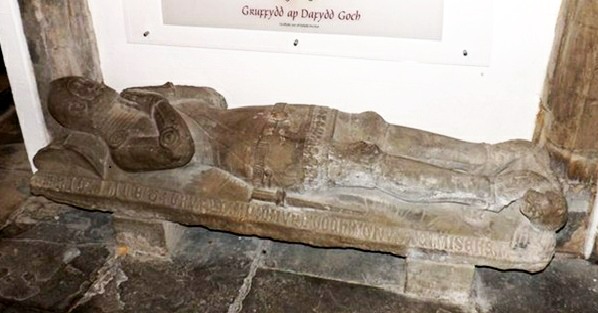
Stone effigy of Gruffydd ap Dafydd Gogh in Betws-y-Coed by Richard Hoare found on geograph.org.uk.
In the ‘Pedigree of Ednowain Bendew 11’. By Darrell Wolcott, which is largely based on the studies and work of Peter Bartrum the following:
‘Cynwrig ap Robert ap Iowerth born c.1340. He married first, Angharad (c.1355) ferch Gruffudd Fychan (c.1325) ap Gruffudd (c.1295) ap Dafydd Goch (c.1260) ap Dafydd ( c.1230) ap Gruffudd (c.1200) ap Llewelyn (c.1170) ap Iowerth of Penmachno (c.1140) ap Nefydd Hardd (c.1105). Nefydd Hardd was Lord of Nant Conwy and descended from Heilig ap Glannog’.
Thus latest scholarship concludes that as 1) the same residence area 2) very similar arms 3) family unharmed when the family of Owain Gwynedd was driven to extinction: then Hywel Coetmor in the late 14C. was likely descended from Nefydd Hardd.
Conclusion
I have done a lot of reading lately and all the research by its nature has been done by scholars/academics, Welsh speaking/reading and having access to manuscripts not available to amateurs like me. We are therefore in their hands to believe them or otherwise and to accept that there are points of argument/doubt amongst them.
Three points, however are conclusive:
- Our family is NOT descended from the ruling family or Princes of Wales despite George Gwynedd holding the name he did.
- George Gwynedd in Gloucestershire obviously thought or had evidence of his ancestry by the arms that his family held being so remarkably similar to that of Nefydd Hardd.
- He came from Caernarvonshire, was obviously educated and of some means.
Research into his wife Eleanor revealed nothing as the name is of Norman/French origin and had long been absorbed into Welsh life. My feeling is that she like George was Anglo/Welsh and they migrated to Gloucestershire in the time of Queen Mary together.
My feeling too is that George was thoroughly converted to Anglo society proven by his forename which is totally English as too was the name of his only son Richard.
None of this research however proves that there is a blood/family connection between George Gwynedd and Nefydd Hardd as it is solely based on the almost identical Arms but it has been an interesting exercise for me. Nefydd’s extended family as has been noted married into other notable Welsh families and became spread on ‘the four winds’. How we fill in the gap between Hywel Coetmor in the late 14th. C. and George Gwynedd in 1575, I don’t know but at the moment it is beyond me although I will keep looking.
I must acknowledge the outstanding work Elizabeth Jack has done researching the Gwinnett family over the years with myself as very much the junior partner. It was by mutual agreement that I should make some attempt to trace the Welsh origins.
Lester Durbin
York, Western Australia.
email: jeanles.1@bigpond.com
5 January 2023.